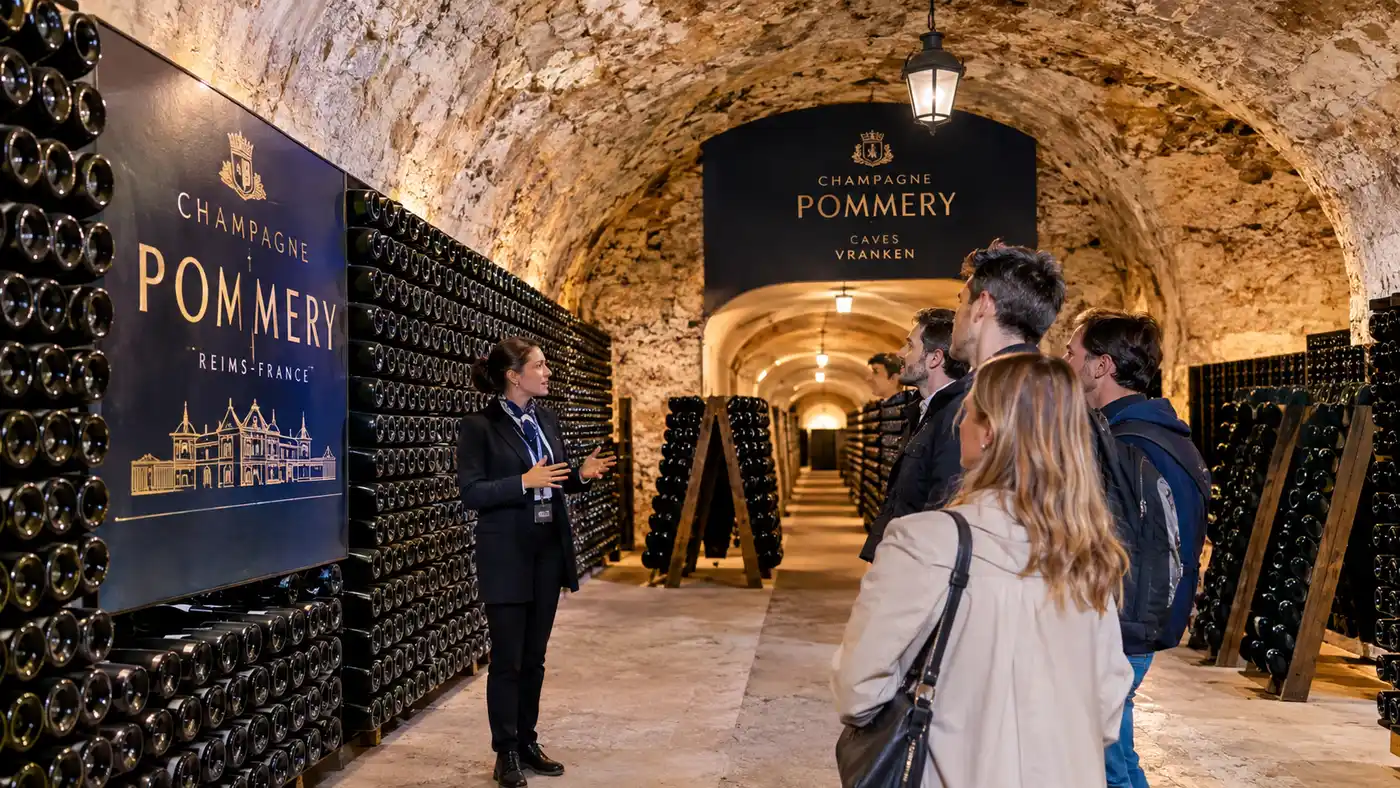
Mumm Pommery Iconic Champagne Caves
Reims looks ordinary enough when you step off the train at the central station, but the real city sits thirty meters below the pavement. Down there, millions of dusty bottles rest in damp Roman quarries that stay cold even in August. If you are planning to spend a day touring cellars, booking mumm and pommery champagne tours gives you two completely different glimpses into how sparkling wine shaped this corner of France.
One house operates with sleek, quiet efficiency right near the city center, while the other sprawls across a hilltop like an eccentric blue Victorian fortress stuffed with modern art. Visiting both gives you a balanced look at the region. You see the technical precision behind a global brand, followed by the grand theatrical ambition of a nineteenth-century widow who changed the way the world drinks wine.
Book your champagne tours from paris experience:
The Roman Chalk Pits Beneath Reims
The ground beneath Reims is hollow. Second-century Gallo-Romans dug into the soft limestone to pull out building blocks for city walls and villas, carving bell-shaped cavities called crayères. Centuries later, winemakers realized these damp shafts maintained a stable temperature of roughly 10 degrees Celsius with high humidity. It turned out to be the exact environment required to ferment and age sparkling wine without spoiling it.
Walking into these tunnels for the first time feels slightly disorienting. The smell hits you right away. It is an earthy blend of wet chalk, old wood, and fermenting yeast. Footsteps echo down corridors that seem to go on forever, with black mold dusting the walls where the air stays wettest. Workers spent their entire adult lives in this perpetual chill, pushing heavy wooden carts and turning bottles by hand in near darkness.
Pro tip: Wear shoes with rubber soles and bring a wool sweater or jacket even in July, because after forty minutes underground the ten-degree chill cuts right through light clothes.
Around 250 kilometers of these cellars crisscross beneath the city. During the First World War, when artillery shells flattened roughly eighty percent of Reims, thousands of residents moved into the caves. They set up hospitals, schools, and dormitories alongside stacked bottles of vintage wine. You can still spot hand-carved graffiti from soldiers and civilians etched into the soft rock walls.
Inside Maison Pommery: Art, Drama, and Madame Pommery
Pommery does not do subtle. When you arrive on the Saint-Nicaise hill, you are greeted by an enormous castle painted in dusty blue and terracotta trim, surrounded by manicured lawns and gravel carriage drives. Jeanne Alexandrine Louise Pommery took over the business in 1858 after her husband died, and she decided to turn the estate into an architectural statement that would dazzle wealthy English buyers.
To visit Pommery properly, you have to tackle the massive staircase. A wide flight of 116 stone steps plunges straight down into the darkness. Standing at the top, looking down the illuminated shaft, the sheer scale of the cellar reveals itself immediately. Madame Pommery hired miners to connect 120 separate Roman chalk shafts, creating an 18-kilometer underground network that held up to twenty million bottles at its peak.
She also commissioned the sculptor Gustave Navlet to carve massive bas-reliefs directly into the chalk faces. His sculpture of Silenus, the companion of Bacchus, still sprawls across a 30-foot wall, carved out of the raw stone under dim gas lamps in the 1880s. Today, the estate uses the subterranean caverns as an underground contemporary art gallery known as the Experience Pommery exhibition. Some visitors find the neon installations and surreal sculptures distracting inside a historic cellar, but honestly, Madame Pommery probably would have loved the spectacle.
She was a genuine innovator in the vineyard as well as on the surface. Back in the nineteenth century, champagne was thick, syrupy, and cloyingly sweet, often served with dessert. In 1874, sensing changing tastes in Victorian Britain, she produced Pommery Nature, the first commercially successful brut champagne. It stripped away the heavy sugar dosage and let the dry acidity of the grapes shine through. The gamble worked, and it permanently altered how the entire region made wine.
Note: The massive central staircase at Pommery has no elevator access for standard cellar tours, so travelers with limited mobility should check directly with the visitor center for alternate ground-level tastings.
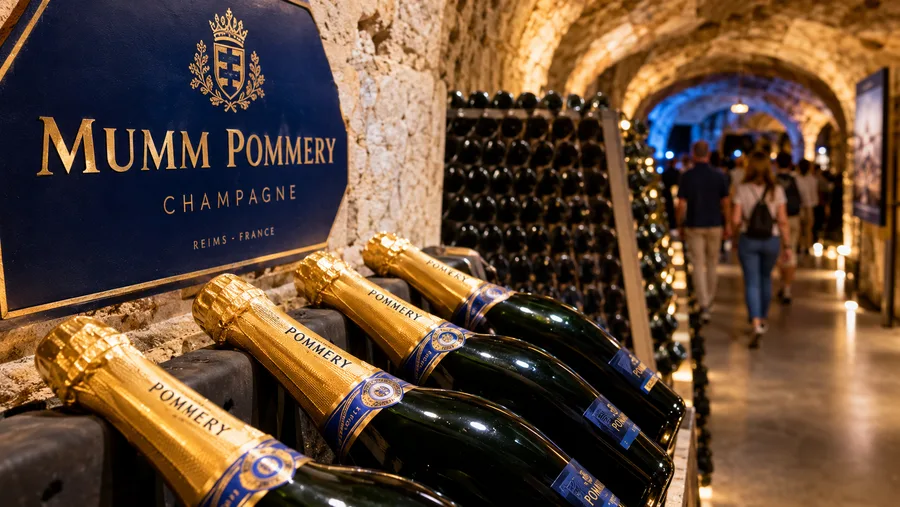
G.H. Mumm: Red Ribbons and Subterranean Precision
Maison Mumm sits on the opposite side of town, tucked into an unassuming residential neighborhood about a ten-minute walk north of the train station. You walk through a modern courtyard into a visitor center that feels far more streamlined than Pommery. Mumm was founded in 1827 by three German brothers, Philipp, Gotthilf, and Jacobus Mumm, along with Friedrich Giesler, coming from a family of wine merchants based in the Rhine Valley.
The tour here focuses heavily on the craft and mechanics of winemaking. Their cellar spans 25 kilometers, though visitors walk a curated loop through several active working areas. You will see enormous oak foudres, rows of traditional pupitres where bottles were once hand-riddled, and long alleys named after the historic clients and cellar masters who shaped the brand. It feels more like an operational production facility than an art gallery, which appeals to travelers who want to understand the chemistry of the secondary fermentation.
The guide walks you through the story of the Cordon Rouge, the red silk sash that still decorates every standard Mumm bottle. Georges Hermann Mumm created it in 1876, drawing inspiration from the ribbon of the French Legion of Honour to mark his prestige cuvées for aristocratic customers. It became an instantly recognizable brand marker worldwide, turning Mumm into one of the largest houses in the world.
The tasting room at the end of the cellar walk is bright and minimalist. Tasting their Grand Cordon side by side with a vintage release or their blanc de blancs gives you a clear sense of how pinot noir dominates their house style. The wines show sharp structure, crisp green apple, and brioche notes that taste noticeably different from the rounder, chardonnay-driven profiles you encounter across town.
Book your champagne tours from paris experience:
Comparing Mumm and Pommery Side by Side
Choosing between these two cellars depends entirely on what kind of traveler you are. Pommery is grand, dramatic, slightly bizarre, and visually overwhelming. Mumm is disciplined, historic, informative, and convenient to reach on foot from the city center. Many people try to see both in a single day, which is entirely doable if you space out your reservations properly.
To help you decide which one matches your schedule, here is how the two visits stack up against each other:
| Feature | Maison Mumm | Maison Pommery |
|---|---|---|
| Location | Northern Reims, near train station | Saint-Nicaise hill, southern Reims |
| Cellar Depth | 14 meters underground | 30 meters underground |
| Stair Count | Around 45 steps down | 116 steps in main descent |
| Base Ticket Price | Around 34 euros (1 glass) | Around 38 euros (1 glass) |
| Tour Focus | History, technique, pinot noir style | Madame Pommery, art, brut history |
| Atmosphere | Clean, historic, educational | Theatrical, gothic, contemporary art |
If you only have time for one stop during a quick afternoon trip, Mumm saves you taxi fares and keeps you close to the center. If you want jaw-dropping underground scale and the Roman crayères at their most impressive, Pommery wins on pure visual impact.
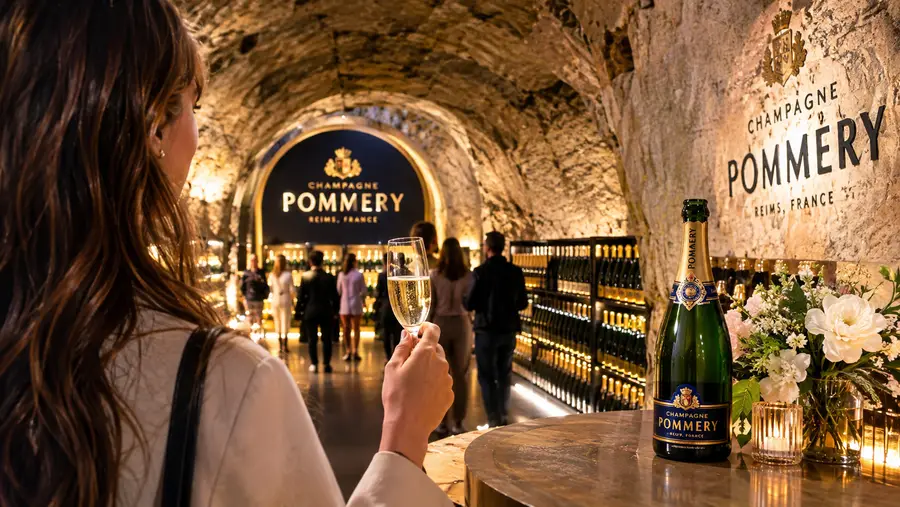
Planning Mumm and Pommery Champagne Tours in One Day
Seeing both houses on the same calendar day requires an early start. They sit roughly three kilometers apart, on opposite ends of the city. Walking between them takes about 40 minutes, cutting right past the Cathedral of Notre-Dame de Reims, where French kings were crowned for over eight centuries. That walk is actually a great way to clear your head between tastings.
Here are the practical logistics to keep in mind when setting up your schedule:
- Morning booking: reserve Mumm for 10:00 or 10:30, which leaves you plenty of time after the morning train arrives from Paris.
- Lunch window: schedule two hours between visits so you can sit down for a meal around Place Drouet d'Erlon or near the cathedral.
- Afternoon booking: book Pommery for 14:30 or 15:00, allowing for a leisurely stroll or a quick 9-euro taxi ride up the hill.
- Advance reservations: buy tickets at least three weeks early during peak months, because weekend English-language time slots fill up rapidly.
After finishing your afternoon tour at Pommery, you are also well positioned to walk over to neighboring estates like Veuve Clicquot or Taittinger. Saint-Nicaise hill is packed with houses, though trying to do three underground tours in twelve hours will numb your palate and exhaust your legs. Two houses in one day is the sweet spot. You taste enough wine to compare house styles without feeling overwhelmed by identical explanations of disgorgement and dosage.
Frequently Asked Questions about mumm and pommery champagne tours
Can you walk between Mumm and Pommery?
Yes, but it takes roughly 35 to 40 minutes at a normal pace. The route cuts directly through central Reims and past the cathedral, making it an easy and scenic walk if the weather is nice. If it is raining or you are short on time, a local taxi or ride-share costs around 9 to 12 euros.
Are the tours conducted in English?
Both houses offer dedicated English-language tours daily. When you book online through their respective websites, make sure you choose an English time slot, as group guides stick strictly to the language designated for that booking.
Which house has better champagne?
That depends entirely on your personal taste. Mumm emphasizes pinot noir, yielding wines that feel structured, crisp, and robust. Pommery leans more toward chardonnay, producing lighter, fresher wines with softer citrus and brioche notes. Comparing the two is the main fun of doing both visits.
Quick Reference
- Cellar temp: constant 10°C (50°F)
- Pommery stairs: 116 steps down
- Distance apart: 3.2 kilometers across town
- Base tour prices: 34 to 38 euros
- Walking time between houses: 35-40 minutes
Book your champagne tours from paris experience:
My Take
Tasting champagne in fancy Paris bars never quite compares to standing twenty meters below the soil where the bottles actually spent years maturing in silence. Booking both Mumm and Pommery gives you the full narrative arc of Reims winemaking - from the commercial discipline of nineteenth-century pioneers to the eccentric brilliance of Madame Pommery carving art halls into Roman stone. Pick your tour slots, grab a warm jacket, and leave enough room in your suitcase to bring a couple of bottles home.
Read more about champagne tours from paris.